Milodomain


Domain authority in SEO: DA, DR, TF, CF explained
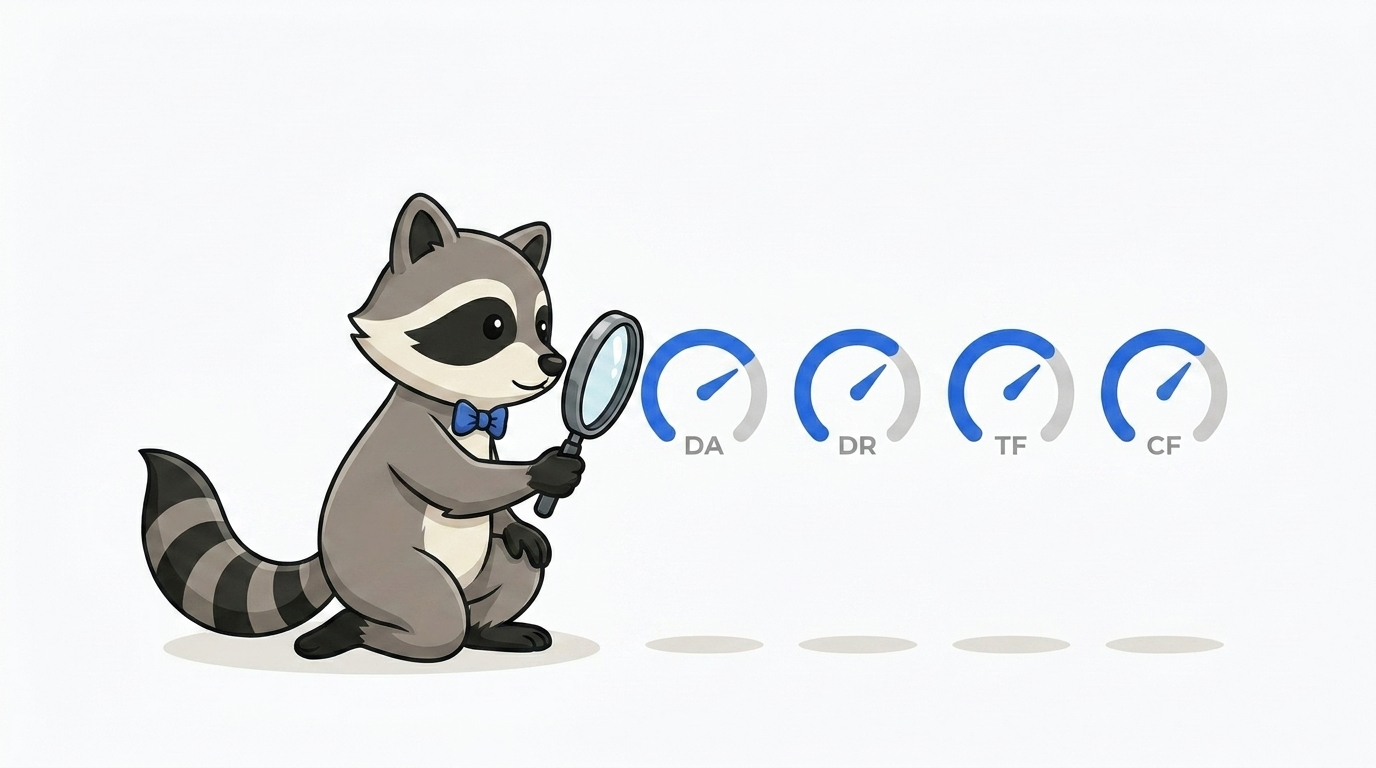
You have probably already heard an SEO consultant talk about the "DA" of a domain, or compare the "DR" of two competitors. Behind these acronyms lie indicators that SEO professionals use daily to evaluate the strength of a site and anticipate its potential on Google. But what do they really measure? Are they all equivalent? Which one to prioritize in 2026?
This article reviews the four most-used authority metrics on the market, DA, DR, TF and CF, their calculation methods, their limits, and how seasoned SEOs combine them to evaluate a domain. By the end, you will also understand why some professionals prefer to inherit existing authority rather than build it from scratch.
Why domain authority matters in SEO
Google has never published an official authority score, but its PageRank patent and Search Quality Rater Guidelines acknowledge that it evaluates a site's reputation in part via its inbound link profile. DA, DR, TF and CF are proprietary estimates from Moz, Ahrefs and Majestic. They serve to compare two domains, evaluate a domain to acquire and measure progress over time.
Google has never published an official authority score. However, in its PageRank patent and in the Search Quality Rater Guidelines updated regularly, the search engine acknowledges that it evaluates a site's reputation partly through its incoming link profile. This idea, that a domain to which many quality sites point inspires confidence, inspired third-party SEO tools to invent their own scores.
Domain authority is therefore not a Google metric. It is a third-party publishers' estimate (Moz, Ahrefs, Majestic, Semrush) of a site's ranking potential. These scores have three main uses:
- Comparing two domains with each other (your own and a competitor's, for example).
- Evaluating the SEO value of a domain you wish to buy, repurchase or recover after expiration.
- Measuring progress over time after a link-building campaign.
None of these scores will tell you that "your site will rank number 1 tomorrow". They do, however, give a reliable order of magnitude, provided you understand what they measure.
Domain Authority (DA), Moz's historical score
Moz's Domain Authority is one of the first consumer authority scores, launched in the early 2010s. Logarithmic 0-100 scale computed by a machine learning model predicting Google positions. The DA is relatively calibrated: going from 70 to 80 takes far more effort than from 20 to 30. Limited by the Moz index, narrower than Ahrefs or Google.
The Domain Authority, or DA, is one of the first mainstream authority scores, launched by Moz in the early 2010s. It is expressed on a 0 to 100, logarithmic scale: moving from 20 to 30 takes much less effort than moving from 70 to 80.
What it measures
The DA is calculated by Moz based on several dozen signals from their own crawl of the web (the Link Explorer index):
- The number of referring domains.
- The quality of these domains (measured by their own DA).
- The total number of backlinks.
- Other link profile signals.
Moz specifies on its Link Explorer Help Center that the score is calibrated using a learning model that tries to predict Google rankings on a sample of keywords. The calibration is therefore relative: a DA 50 today is not exactly equivalent to a DA 50 from two years ago, because the average of the web shifts.
Typical values
- 0 to 20: new domain or very weakly linked site.
- 20 to 40: established site, active blog with a handful of good backlinks.
- 40 to 60: solid authority, many SMEs in e-commerce and specialized media.
- 60 to 80: large national brands, established media.
- 80 to 100: top of the web (Wikipedia, Le Monde, Amazon, gov sites).
Limits
The DA is only fed by the Moz index, which is more restricted than that of Ahrefs or Google. In niche markets (for example, the highly specialized French-speaking market), the DA may underestimate reality. It is also manipulable in the short term by spam techniques, which is why Moz recalibrates regularly.
Domain Rating (DR), Ahrefs's metric
Ahrefs' Domain Rating is on a 0-100 logarithmic scale. Conceptually simpler than DA, it depends solely on the number of unique referring domains and the DR of each, computed iteratively in the spirit of the original PageRank. It reacts faster to new backlinks, covers international domains better, and remains the main metric for French-speaking SEOs in 2026.
The Domain Rating, or DR, is the equivalent offered by Ahrefs, considered today as the SEO tool with the largest backlink index on the market. Like the DA, it is expressed on a 0 to 100, logarithmic scale.
What it measures
The DR is conceptually simpler than the DA. According to the Ahrefs blog, it depends on two main variables:
- The number of unique referring domains pointing to the evaluated domain.
- The DR of each of these referring domains.
The idea: a link from a domain with high DR counts more than a link from a domain with low DR. The score is calculated iteratively, in the manner of the original PageRank. Ahrefs specifies that the DR does not take into account certain factors such as topical relevance or organic traffic, which makes it a metric purely tied to link-based authority.
Comparison with the DA
In practice, DR and DA are strongly correlated: a domain with DA 60 will often have a DR between 55 and 70. But notable gaps exist:
- The DR reacts faster to new backlinks (Ahrefs crawls more frequently).
- The DR covers international domains better, particularly in French, German, Spanish.
- The DA takes into account some signals that the DR ignores (formerly, direct ranking on a few keywords).
Many SEO professionals in 2026 use DR as the main metric for French-speaking domains, with DA as a complement.
Trust Flow (TF), quality according to Majestic
Majestic's Trust Flow measures the trustworthiness of the link profile. 0-100 scale. It starts from a manual list of ultra-reliable seed sites (Wikipedia, BBC, Harvard, gov) and evaluates a domain's proximity to those sources. A domain can have 100,000 spam backlinks and a very low TF. The Topical Trust Flow per theme reveals sectoral inconsistencies.
The Trust Flow, or TF, is one of the two flagship scores published by Majestic, one of the pioneers of backlink analysis (launched in 2008). Scale 0 to 100.
What it measures
The TF is designed to answer a precise question: are the links pointing to this domain trustworthy? To calculate it, Majestic starts from a manual list of "seed sites" that are highly reliable (Wikipedia, BBC, Harvard, government sites). The more a domain is linked, directly or indirectly, via short redirect chains, to these trusted sources, the higher its Trust Flow.
The TF is therefore qualitative: it favors links from recognized sources. A domain may have 100,000 spam backlinks and a very low Trust Flow. Conversely, a domain with 50 backlinks coming from educational or institutional sites may show a TF of 30 or more.
Topical Trust Flow
Majestic also publishes Topical Trust Flow by topic (Health, Technology, Business, Recreation, etc.). This shows where a domain's trust comes from. A site supposed to be specialized in finance whose main TF comes from the "Adult" topic is suspect.
Citation Flow (CF), quantity according to Majestic
Citation Flow is the quantitative counterpart of Trust Flow at Majestic, on the same 0-100 scale. It measures the raw strength of the link profile: how many domains point in, how many links, how often. The TF/CF ratio is critical: above 0.7 indicates a clean profile, between 0.4 and 0.7 a mixed profile, below 0.4 a spam signal.
The Citation Flow, or CF, is the quantitative counterpart of Trust Flow. Scale 0 to 100. It measures the raw strength of the link profile: how many domains point to the site, how many links, at what frequency.
The CF answers "how many"; the TF answers "what quality". A domain may very well have a CF of 50 and a TF of 12, meaning it has many links, but mostly from unreliable sources. SEOs therefore monitor the TF/CF ratio:
- TF/CF ≥ 0.7: clean, qualitative link profile.
- TF/CF between 0.4 and 0.7: mixed profile, requires detailed analysis.
- TF/CF < 0.4: spam signal, to investigate or avoid.
This ratio is one of the first reflexes when auditing a domain, especially if you intend to acquire it.
Which score to prioritize? Comparison table
No score is universally superior. Professional SEOs combine four metrics: Ahrefs DR as main authority indicator, Majestic TF/CF for link profile quality, Moz DA as second reading for historical comparisons, and Semrush Authority Score as a complement. A manual audit of the 100 or 200 most powerful backlinks remains essential beyond scores.
None of these scores is "the right one". Each one sheds light on a facet of the domain. Here is a summary:
| Score | Publisher | Scale | Measures | Strength |
|---|---|---|---|---|
| DA | Moz | 0-100 log | Global ML estimate | Reputation, age |
| DR | Ahrefs | 0-100 log | Link profile strength | Wide, fresh index |
| TF | Majestic | 0-100 | Link quality | Reliability, anti-spam |
| CF | Majestic | 0-100 | Link quantity | Raw volume |
In practice, professional SEOs in 2026 use these metrics in combination:
- Ahrefs DR as the main authority indicator (broadest coverage).
- Majestic TF/CF to verify link profile quality.
- Moz DA as a second reading, for historical comparisons.
- Semrush Authority Score or Page Authority as a complement when the tool is already in the stack.
And always, to go further: a manual audit of the link profile on the top 100 or 200 most powerful backlinks. No score, however sophisticated, replaces an experienced SEO's eye.
How to inherit a domain's authority without building it for 5 years?
Building a DR of 40 on a fresh domain takes several years of editorial work and PR. Recovering an already-authoritative expired domain is an alternative path known to professionals. Specialised platforms like Milodomain secure drop-catching via an AFNIC-accredited registrar, then auction the domain publicly. Requires a rigorous link profile analysis.
Building a DR of 40, a TF of 25 or a DA of 45 on a new domain takes, in practice, several years of editorial work, public relations, and partnerships. For many projects, this delay is incompatible with the market window.
There is an alternative path known to SEO professionals: recovering an expired domain that has already accumulated significant authority. When a domain owner does not renew their registration, the domain becomes available again at the registry. A buyer can then take it back, with its backlinks, its age, its history. This is what is called drop-catching. For .fr, specialized platforms like Milodomain secure the operation through an AFNIC-accredited registrar, then award the domain via public auction.
This approach allows starting a project on a base already solid in terms of authority. It does, however, require rigorous analysis of the link profile (TF/CF), topical history (consistency with the project), and absence of prior penalties. To understand in detail the lifecycle of a domain and the pitfalls to avoid, consult our complete guide on what is an expired domain, or browse the definitions of the main SEO indicators in our glossary.
Conclusion
DA, DR, TF, CF each illuminate one facet of the same question: how strong is a domain? None replaces a manual analysis, but their combination gives a quick, useful reading. In 2026, rigorous SEOs cross-reference these scores, examine their discrepancies and never forget that final authority is judged by Google, not by a third-party score.
DA, DR, TF, CF: four letters, four complementary angles on the same question, what is a domain's strength? None of these scores replaces a manual analysis, but they provide a quick and useful reading. In 2026, the most rigorous SEOs combine them, check the gaps between them, and never forget that final authority is judged by Google, not by a third-party score.
Whether you are building a site from scratch or considering recovering an expired domain, the combined reading of these metrics remains an essential of professional SEO.
FAQ
Synthetic answers to the classic questions: difference between DA and DR, official-or-not status of these scores on Google's side, healthy TF/CF ratio, DR evolution after acquiring an expired domain, and need or not for a paid tool to consult these scores. Free limited versions are enough for occasional checks.
What is the difference between DA and DR?
The DA (Moz) is calculated by a learning model that predicts Google rankings from several signals. The DR (Ahrefs) is simpler: it depends only on the number and authority of referring domains. In practice, DR is often preferred for French-speaking domains because the Ahrefs index is broader.
Is Domain Authority an official Google score?
No. None of the DA, DR, TF, CF scores is published by Google. They are proprietary metrics from Moz, Ahrefs and Majestic. Google has never confirmed using a comparable authority score, although the original PageRank relied on similar logic.
What TF/CF ratio is considered healthy?
A Trust Flow / Citation Flow ratio of 0.7 or higher generally indicates a clean link profile. Between 0.4 and 0.7, the profile is mixed and deserves manual analysis. Below 0.4, it is a spam signal: many links, but little quality.
How does a domain's DR change after buying an expired domain?
The DR of an expired domain theoretically remains the same at the moment of takeover, since backlinks are preserved. However, some links may disappear over time if referring sites are updated or remove their links. That is why a profile audit before purchase remains essential.
Do you need to buy a paid tool to consult these scores?
For occasional consultations, most publishers offer a limited free version: Moz Link Explorer (3 queries per day), Ahrefs Backlink Checker public, Majestic Site Explorer (limited). For regular professional use, a paid subscription (Ahrefs, Semrush, Majestic) remains essential.
Going further
Once the authority indicators are mastered, two complementary resources close the loop: understand how a domain expires and can be recovered via drop-catching or backorder, and access precise definitions of all SEO technical terms via the dedicated glossary. These readings make domain evaluation more rigorous and systematic.
Once the indicators are mastered, two complementary resources:
- Expired .fr domains, drop-catching and backorder: the complete 2026 guide, to understand how domain recovery works concretely.
- SEO and domain name glossary, for precise definitions of all technical terms.