Milodomain


Buying a domain name for life: prices, alternatives and strategies
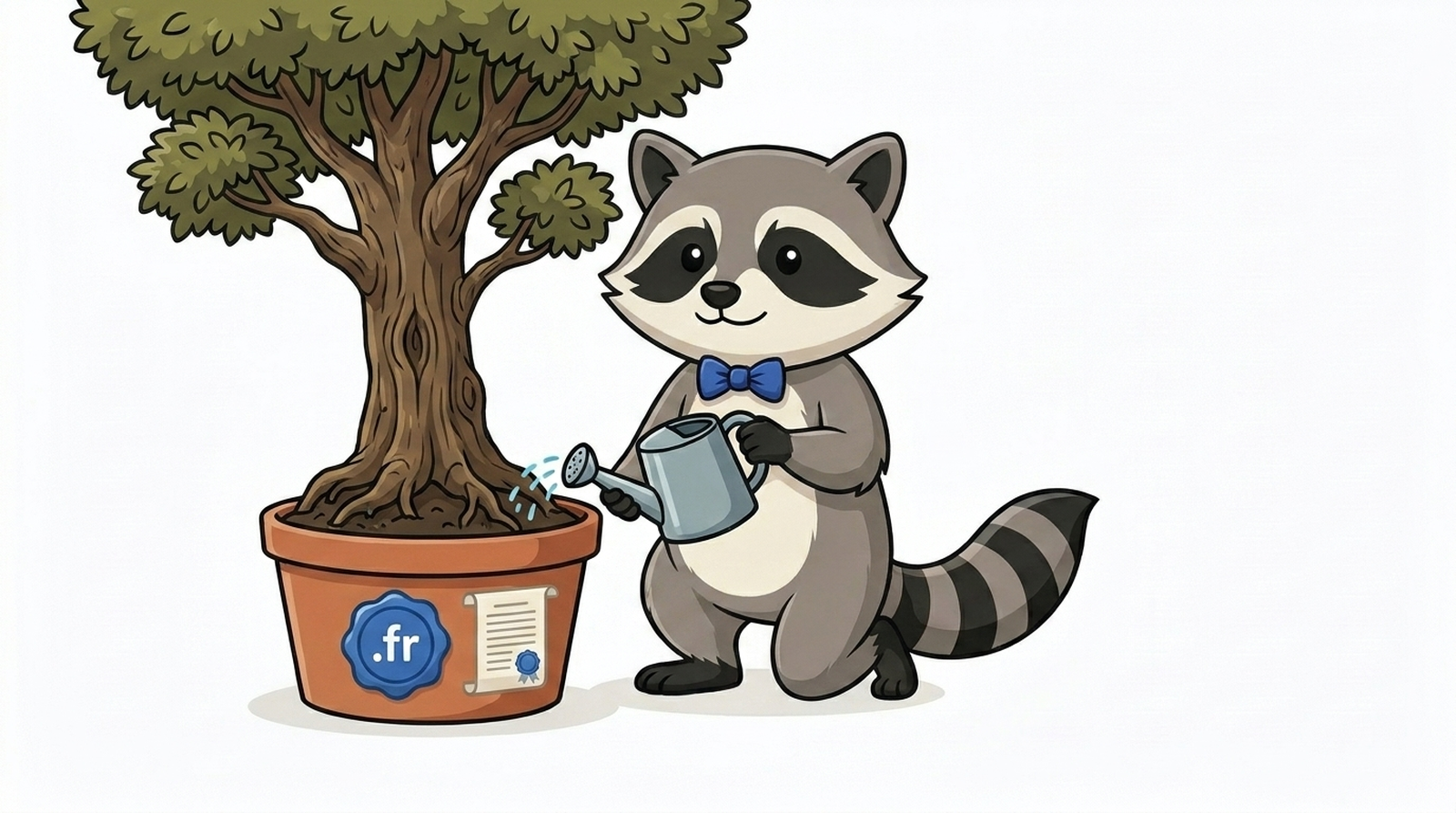
The phrase « buying a domain name for life » comes up regularly in Google searches. It reflects a legitimate need, durably securing a strategic name without risk of forgetting renewal, but rests on a misconception: no registry in the world sells a domain name as full perpetual property. A domain name is always an annual lease with a registry. This article demystifies this question, details the real cost of long-term holding, and presents the effective strategies to secure a name over 10, 20 or even 50 years.
Why the lifetime domain does not exist (legally)
A domain name is not a piece of real estate of which you become a perpetual owner. It is an annual right of use, granted by a registry (AFNIC for .fr, Verisign for .com, etc.) subject to payment of an annual fee. This fee, typically 8 to 15 EUR excl. VAT/year for a .fr, covers the entry in the official DNS database, the technical resolution of the name and the administrative registration of the holder.
This model is universal. All global registries work this way: no perpetual ownership, only renewable leases. The structural reason: a registry must be able to recover abandoned names to return them to the market, otherwise the pool of available names would run dry. These abandoned names are precisely what makes up the expired domain market.
The phrase « buy for life » is therefore a misleading marketing shortcut. What you can actually do is reserve for a long time and automate renewal to eliminate the risk of forgetting.
Maximum reservation duration: what is possible in 2026
Each registry sets its own maximum initial or early-renewal duration. Overview of the main extensions in 2026.
.fr (AFNIC)
Maximum registration duration 10 years in a single operation. You can then renew in successive 1-to-10-year tranches. Average rate: 8-15 EUR excl. VAT/year at consumer registrars, sometimes up to 30 EUR excl. VAT/year at some specialised resellers. Total cost for 10 years: 80 to 150 EUR excl. VAT paid upfront.
.com (Verisign)
Maximum duration 10 years in a single operation, identical to .fr. Average rate: 10-20 USD/year. Total cost 10 years: 100 to 200 USD.
.net, .org
Same rule, maximum 10 years in one operation. Rates similar to .com.
Other extensions
Most European ccTLDs (.de, .it, .es, .nl) cap at 1 or 10 years depending on the registry. Some new gTLDs (.app, .dev, .shop) allow up to 10 years as well. Some exotic extensions limit to 1 or 2 years.
Real cost of long-term holding
Here are the total cost ranges for a .fr in France, assuming an average rate of 12 EUR excl. VAT/year and price stability (.fr rates have historically varied between 8 and 15 EUR excl. VAT/year over the last decade, with no strong upward trend).
- 10 years: 120 EUR excl. VAT, payable in one go.
- 20 years: 240 EUR excl. VAT, in two 10-year payments.
- 50 years: 600 EUR excl. VAT, in five 10-year payments.
- 100 years: 1,200 EUR excl. VAT, in ten 10-year payments (subject to AFNIC continuity and rate stability).
For comparison: a premium name bought on the secondary market typically costs 1,000 to 10,000 EUR for the acquisition (see our guide buying back an expired domain), to which classic annual renewals are added (8-15 EUR excl. VAT/year).
Credible alternatives to buying for life
Three effective strategies allow you to secure a name long term without risk of forgetting, without depending on the legal myth of perpetual ownership.
Strategy 1, Automatic renewal over 10 years
Reserve your name 10 years in advance at a reliable registrar (OVH, Gandi, Cloudflare Registrar for .com). Set up auto-renewal with a valid credit card, and schedule a calendar reminder at T-12 months before expiration to update the payment method if necessary. Cost: 120 EUR excl. VAT for 10 years of .fr. Risk: forgetting if the card expires and registrar alerts go unnoticed.
Strategy 2, Holding via a long-lived structure
For a critical company name, the holder must be the company itself, not an executive in a personal capacity. This guarantees continuity beyond personnel or ownership changes. Make sure to maintain valid administrative contact details (company email, not a personal email of an executive who will one day leave the company). Cost: identical to standard renewal. Risk: fragile continuity if the company disappears.
Strategy 3, Third-party monitoring service
Paid services (DomainTools, MarkMonitor, CSC Digital Brand Services) offer name-portfolio monitoring with cross alerts: if your card expires, if your registrar fails, if a contact is no longer current, you receive multiple alerts. Cost: from a few dozen euros per month for entry-level services, up to several hundred for corporate solutions. Relevant for companies with portfolios of critical brands.
Patrimonial securing of a domain name
Beyond renewal, several levers help secure a name in the patrimonial sense: legal continuity, protection against capture, succession transmission.
Activate the transfer lock (Registrar Lock)
All serious registrars offer a lock preventing any unauthorised transfer to another registrar. Activate it by default, disable it only for legitimate transfer operations. Protection against domain hijacking and registrar account hacks.
Multi-factor authentication on the registrar account
Activate 2FA (via TOTP, or YubiKey hardware for critical accounts) on your registrar account. It is the first line of defence against phishing or credential stuffing compromises.
Consistency of administrative contacts
The email of the administrative contact is the most common point of failure. If the email expires (closed mailbox, employee gone), you no longer receive renewal alerts. Maintain a long-lived company email (e.g. [email protected]) and check it every six months.
Succession transmission
For an individual, plan in your will to transmit the name portfolio to an heir, with the necessary credentials (in a digital vault such as 1Password Family or Bitwarden). For a company, transmission is via the transfer of company shares.
The « lifetime domain » myth
Some marketing offers abroad propose « lifetime domains », typically packages combining the maximum allowed reservation (10 years) + an automatic pre-renewal service managed by the seller. These offers are not frauds per se, but they often hide: an inflated price (sometimes 500 to 2,000 EUR for what you would get for 120 EUR elsewhere), an opaque commitment on future renewals (the seller may go bankrupt), commercial dependence on the seller (transfer out of their ecosystem complicated).
Our recommendation: prefer a transparent 10-year reservation at a mainstream registrar, plus 2FA monitoring and up-to-date contact details. Cheaper, safer, more mobile.
FAQ, Frequently asked questions
Can a domain name really be bought for life?
No, legally it is impossible. No registry in the world sells perpetual ownership of a domain name. The universal model is the renewable annual lease, managed by the registry (AFNIC for .fr, Verisign for .com, etc.). What you can do in practice: reserve for the maximum allowed duration (10 years for most extensions), set up automatic renewal, and keep administrative details up to date. Marketing offers of « lifetime domain » almost always hide a simple 10-year package + monitoring, sold at a premium.
What is the maximum reservation duration of a .fr?
10 years in a single operation. You can reserve for 1, 2, 5 or 10 years as you choose, paying the full amount in advance. Beyond that, you will have to renew a second time for another 10 years. This rule is uniform across all AFNIC-accredited registrars (OVH, Gandi, Online, etc.). Some commercial offers propose a « 20-year pack », but behind the marketing, technically it is always two successive 10-year renewals managed for you by the registrar.
How much does a .fr reserved for 10 years cost?
Typically 80 to 150 EUR excl. VAT paid in advance, i.e. 8-15 EUR excl. VAT/year depending on the registrar. OVH, Gandi and Online offer the most competitive rates. Some specialised resellers (SME, enterprise focus) charge up to 30 EUR excl. VAT/year, but offer additional services (monitoring, priority support, advanced DNS management). For a critical company name, the extra cost may be justified; for a standard name, mainstream registrars are sufficient.
What happens if I forget to renew?
The domain enters a redemption phase (about 30 days for .fr), during which you can still recover it against restoration fees (typically 50 to 150 EUR excl. VAT). During this redemption, WHOIS/RDAP shows the « redemption period » and « pending delete » statuses simultaneously: there is no separate intermediate phase. Once the 30 days have elapsed, AFNIC deletes the name then releases it in an hourly batch (at minute :32 UTC); the expired .fr domain then becomes registrable again by whoever wants it, via dropcatch or classic acquisition. The risk is that an opportunistic player captures your name at the moment of the drop and resells it to you expensively, or worse, exploits it in your place. Prevention is by far the best protection: automatic renewal + up-to-date contact details.
What is the difference between « buying » and « renting » a domain name?
None legally: buying a domain name is technically an annual lease with the registry. Commercial vocabulary talks about « buying » because the transaction transfers a right of use and exploitation to the holder. But this right is conditional on annual payment of the fees. If you do not renew, you lose the right. This is different from a piece of real estate or a car, which are full and perpetual properties once acquired.
Can a domain name be bequeathed to heirs?
Yes, but it requires preparation. For a name held personally, provide in your will for the explicit transmission of the registrar credentials to a designated heir. Store these credentials in a digital vault (1Password Family, Bitwarden) accessible to the heir. For a critical professional name, prefer holding via a company: transmission happens automatically with the transfer of shares according to inheritance law. In all cases, the heir will have to continue paying the annual renewals to keep the name.
Are « lifetime domain » services scams?
Not necessarily scams, but often premium marketing offers. The service generally combines the maximum allowed reservation (10 years) + a commitment to automatic renewals managed by the seller. The price is typically inflated (500 to 2,000 EUR for what is worth 120 EUR elsewhere), the contractual commitment is opaque (the seller may disappear), and mobility is compromised (transfer to another registrar made complex). The recommendation is to always prefer a transparent reservation at a mainstream registrar, paying annual fees directly to an established player.
Going further
Securing a domain name long term involves three levers: 10-year reservation + auto-renewal, account security (2FA, registrar lock), durable administrative contacts. To understand the full lifecycle of a .fr and the risks of forgetting, read what is an expired domain. To see how renewal lapses create acquisition opportunities, see our guide buying back an expired domain name. If you are looking for a premium name already loaded with SEO authority, the Milodomain catalogue offers hundreds of .fr expired or about to expire, ready to be acquired for a serious project.